 | ||||
Hexapods — 6-Axis Stages — 6-DOF Parallel Kinematic Stewart Platforms
|
||||
|
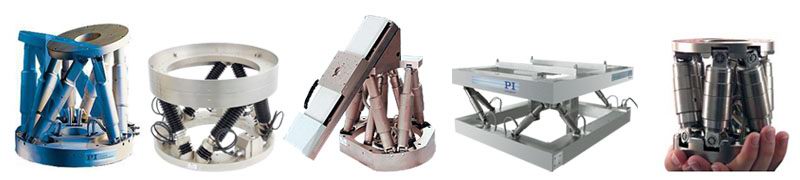
Hexapod 6-Axis stages (6-DOF Stewart Motion Platforms) are used for precision alignment and positioning in industries including optics, photonics, automotive, semiconductors and nano-scale automation. Even if your application only requires a traditional 4-axis stage or 5-axis stage, the flexibility of a hexapod is worth considering this superior technology. PI is the global leader in hexapod based precision motion control systems. With more than 1400 employees world wide, 50 years of experience in nanopositioning and motion control and 3 decades of hexapod mechanics, motion controller and software design experience, PI provides the broadest and deepest portfolio of precision motion techologies and can match your application to the appropriate technology better than anybody else.
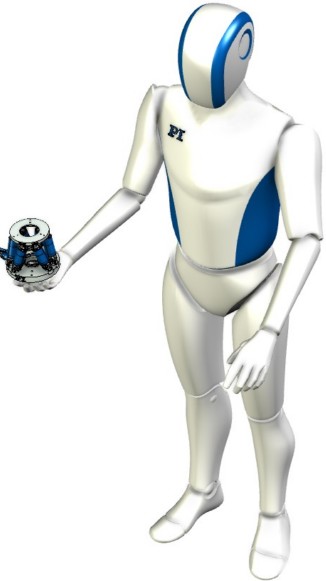
PI 6-axis hexapods are available for different conditions and applications from ambient to vacuum and non magnetic. A new motion simulator, high-speed, linear motor hexapod is also available. PI recently acquired several motion control companies, with design experience in hexapods, air bearings and industrial motion controllers for laser machining to provide an even broader product offering. Learn more - Hexapod FAQs. Our electro-mechanical and piezoelectric Hexapod Stewart-platforms have many advantages over hydraulic hexapods. They are smaller, provide much higher precision and most are self locking. Hexapods are available in many sizes, configurations for small loads from 2 kg to heavy loads of several tons. A recent investment in new building with test equipment and metrology for high load hexapods / positioners has allowed us to further strengthen our leading position. All of PI's hexapods are available with dedicated 6-axis motion controllers. |
|
|
|
|
|
Example: Parallel-Kinematics Micropositioning Systems vs. Serial Kinematics (Stacked) Systems |
Advantages of Parallel Kinematics (PKM) Micro- and Nanopositioning Systems: |
|||
|
Parallel Kinematics 6-Axis Hexapod Robots / Micropositioning System.
|
Serial-Kinematics "Stacked" 6-Axis Stage.
|