Bookmark this site
 Deutsch

Download / Support
Technotes
NanoInnovation Grant™


Why Hexapod Robots and Parallel Kinematics (PKM)?

Advantages of Parallel Kinematics (PKM) Micro- and Nanopositioning Systems: Example: Parallel-Kinematics Micropositioning Systems vs. Serial Kinematics (Stacked) Systems

  • Lower Inertia
  • Better Dynamic Behavior
  • Smaller Package Size
  • Higher Stiffness
  • No Accumulation of Position Errors
  • Reduced Runout Errors
  • No Moving Cables: Better Repeatability and
    Reliability

M-850 Hexapod shown in
different positions.

Click here to see M-840
Hexapod video
(mpeg format)


Parallel Kinematics Hexapod Robot 6 DOF MicroPositioning System. 
  • Six struts support one common lightweight platform. 
  • No accumulation of runout errors. 
  • Virtual center of rotation, set by one software command. 
  • No moving cables, no cable tension for better repeatability and higher reliability. 
Serial-Kinematics "Stacked" Stage 6 DOF MicroPositioning System.
  • The bottom stage supports its own moving platform plus all stages above. 
  • Runout errors and tilt errors accumulate. 
  • Up to 5 moving cables cause friction and cable management problems. 
500 page PI Catalog

Get the new 500
    page PI Catalog
The above comparision clearly shows the advantages of the low-inertia hexapod approach over a classical serial kinematics system.


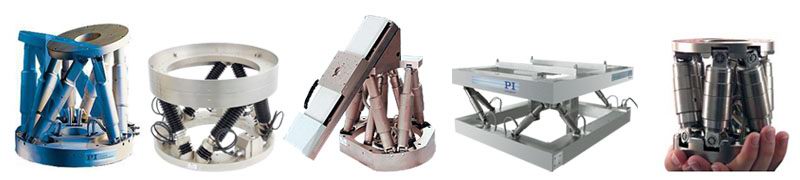
PI Hexapod Product Examples

M-850 Hexapod M-824 Vacuum-Compatible Hexapod M-840 HexaLight Hexapod

M-850 Hexapod NEW M-824 Ultra-Compact
    Vacuum Compatible Hexapod
M-840 HexaLight Hexapod

F-206 Micro-Hexapod Custom Water-Resistant Hexapod Custom High Precision Non-Magnetic Hexapod

F-206 Micro-Hexapod Custom Water-Resistant
    Hexapod
Custom High Precision non-
    magnetic Hexapod with
    NEXLINE® Piezo-Walk® Drives

Active Uptilt Mirror Hexapod Custom Hexapod for Brain Surgery

Downloads

Hexapod Datasheets
Hexapod Applications
Click here to see M-840 Hexapod
    video (mpeg format)
Parallel-Kinematics Technotes
Hexapod Information in German

Active Tip/Tilt Mirror for
   Telescopes
Hexapod as Surgical Robot
    (photo courtesy of IPA)

More Hexapod Links

University of Bremen Study uses PKM Hexapod for Photothermics / Non-Destructive Testing
In-Situ Surface Diffractometer Hexapod
Hexapod Robot in a Beamline
http://hexapod.zemris.fer.hr/pregled_postojecih.htm
http://www.ntu.edu.sg/mpe/research/researchnews/vision-n-control.pdf
http://ppsc.pme.nthu.edu.tw/~htwu/rs/left/robot_link.html
Hexapod Satellite Antenna Control
Robot Tools
Robotics
Hexapod as Surgical Robot
PI Custom Hexapod Robot for Spine Surgery
Hexapod for Active and Passive Fiber Alignment
Hexapod Alignment System for UKIRT Telescope
Hexapod in Dental Research Application (German)
Hexapod for Secondary Mirror Control in SOFIA telescope
Hexapod in Waveguide Alignment Application
Hexapod as Mirror Manipulator in the SRRC Beamline
Hexapod for ALMA Millimeter Radio Telescope

Parallel Kinematics Piezo-Drive Nanopositioning Systems

Serial Kinematics vs. Parallel Kinematics in Nanopositioning Systems


Stacked Serial Kinematics Flexure Nanopositioning System
  • Simple Design, but: 
  • Slower response (lower stage carries inertial mass of upper stage);
  • Non-symmetric resonant frequencies (lower stage is slower than upper stage, requires different servo settings).
  • Orthogonality error is mounting-angle dependant.
  • Runout in Y cannot be monitored/compensated by the sensor in the X stage or vice versa. 
Nested Serial Kinematics Flexure Nanopositioning System
  • Thinner and better response than Stacked Serial Kinematics, but no other advantages
Parallel Kinematics Flexure Nanopositioning System
  • Same ultra-low inertia for X and Y motion, providing higher responsiveness and axis-independent performance. 
  • Excellent, mounting independent orthogonality. 
  • Reduced runout: X sensor (PI uses non-contact two plate capacitance sensors) can monitor and correct for Y runout and vice versa (Active Trajectory Control). 
  • Additional rotation axis (Theta Z) feasible with 3 actuators / sensors and digital controller.

Active Trajectory Control
Active Trajectory Control requires parallel metrology feedback. It is available on single module parallel kinematics nanopositioning systems. It improves straightness and flatness to sub-nanometer precision. Digital controllers with
advanced coordinate transformation algorithms allow active trajectory control for up to 6 DoF.

More information on advanced control techniques for piezo nanopositioning systems


More Information on Low-Inertia Nanopositioning Systems?


Examples of Parallel Kinematics Nanopositioning Systems


Custom 6 DOF Nanoposititioning Stage P-587 Nanopositioning Stage P-733 XY Nanopositioning Stage
Custom 6 DOF Single-Module
    Multi-Axis Design, Capacitive
    Feedback, Clear Aperture.
P-587 6-DOF Most Advanced
    Nanopositioning Stage.
    Travel to 800 µm and 1 mrad.
P-733 XY Nanopositioning
   Stage. Capacitive Feedback,
   Clear Aperture.

P-734 Nanopositioning Stage 541 Piezo Scanning Stage P-714 Low-Profile XY Scanner
P-734 Ultra-High Flatness XY
    Nanopositioning Stage. Capacitive
    Feedback, Clear Aperture.
P-541 Low-Profile, XY
    Piezo Scanning Stages for
    Microscopy. To 200 x 200 µm
    Travel Range. Clear Aperture
P-714 Low-Profile XY Scanners for
    Imaging.Compact Size, Highly Cost-
    Efficient Design, Clear Aperture.


Examples of Parallel Kinematics Steering Mirrors

Parallel Kinematics Differential DriveTriple-Piezo-Drive Active Optics Platform
Parallel Kinematics
    Differential Drive
Triple-Piezo-Drive Active Optics Platform Featuring
    3 Actuators and 4 Sensors

S-330 Piezo Tip/Tilt Platforms S-316 3-Axis Steering Mirror Active Tip/Tilt mirror for Subaru Telescope
S-330 Ultra-Fast Piezo
    Tip/Tilt Platforms
S-316 High-Speed, 3-Axis Tip/Tilt
    Steering Mirror
Active Tip/Tilt mirror for Subaru
    Telescope (Mauna Kea, Hawaii).


© 1996-2006 PI (Physik Instrumente) L.P. All Rights Reserved. Specifications subject to change without notice.


Hexapods Home   Piezo Actuators   Nanopositioning Catalog   Piezo Nano-Positioning and Parallel Kinematics    Ultrasonic Piezo Motors